
AI Visibility for UK Websites: Where You Stand on Google and in AI Answers
AI visibility is whether ChatGPT, Claude, Gemini and Perplexity name your business when somebody asks what to buy or who to use. Search visibility is where Google puts you for the same questions. Sondavo, built by the team behind EveryHost, reports both in one place for any website: your own Google Search Console data for rankings, and real sampled answers from the four assistants, asked as a UK searcher where the engine allows it. The first check is free and needs no account.
What AI visibility means, and why the UK answer is different
AI visibility means being named, or cited, when an AI assistant answers a question your customers ask. Named is the assistant writing your business into its shortlist. Cited is the assistant reading one of your pages before it answered, whether or not it named you. The two are different, and both matter: a citation with no name means the assistant trusts your page but not your brand, and a name with no citation means it is working from memory, which can go stale.
Two things make this harder to measure than a Google ranking. The first is that answers change. The same question asked on Monday and Thursday can produce different shortlists, so a single check on a single day proves almost nothing. The second is location. A shopper in Leeds and a shopper in Ohio can get different recommendations from the same assistant, because the engines that support location use it. A check that asks from the United States is measuring somebody else's market. Any method worth trusting asks from the UK, repeats the same questions on a schedule, and records what was said each time.
How to check your AI visibility
You can check your AI visibility by hand in an afternoon. The method is simple and it is the same one Sondavo automates.
- Write down the questions your customers actually ask, in their words: "best waterproof walking boots under £150", "who repairs boilers in Reading", "cheapest way to host a Magento store". Not your brand name. Searching your own name tells you whether the assistant has heard of you, which overstates your visibility badly.
- Put each question to ChatGPT, Claude, Gemini and Perplexity from a UK location.
- For every answer, record which businesses were named, in what order, and which pages were cited or read.
- Repeat the same set of questions on a fixed schedule, weekly at least, because one test on one day proves nothing.
- Compare the businesses the assistants named with the sites that outrank you on Google for the same questions. The overlap is where the work is.
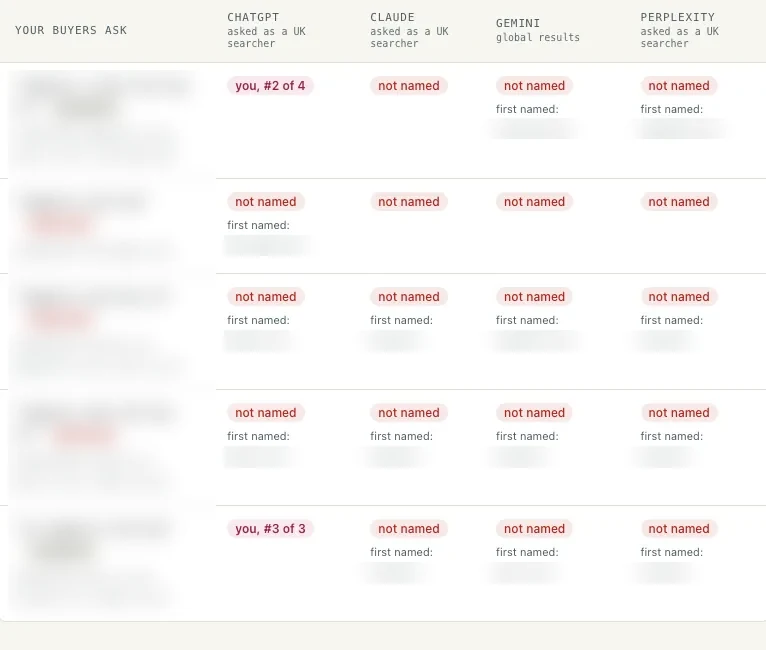
Sondavo runs that method for you. You choose the buyer questions, it puts them to the four assistants on a schedule set by your plan, stores every answer verbatim with its date and the sources the assistant read, and records the first-named rival wherever you were not named. ChatGPT, Claude and Perplexity are asked as a UK searcher; Gemini returns global results, and the report says so.
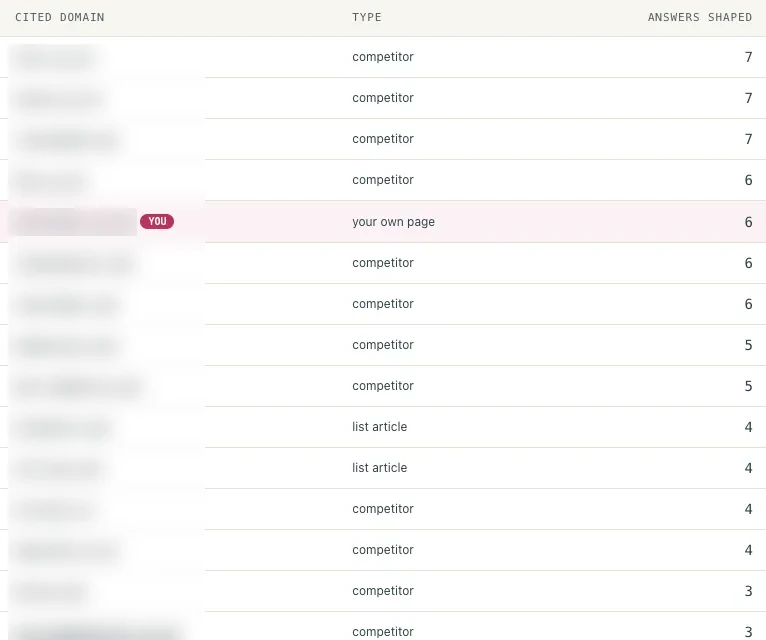
The second view turns the answers round: which domains shaped them. Every cited source is listed with the number of answers it influenced, and labelled as a competitor, a list article or your own page. It is the quickest way to see who the assistants trust in your market, and list articles usually appear high on it, which is a clue about where to earn a mention.
The detail of how the sampling works, and what it costs per answer, is on Sondavo's AI visibility page. If you only want to test ChatGPT by hand first, Sondavo's guide to checking whether ChatGPT mentions your website walks through it.
Google rankings from your own data, not a guess
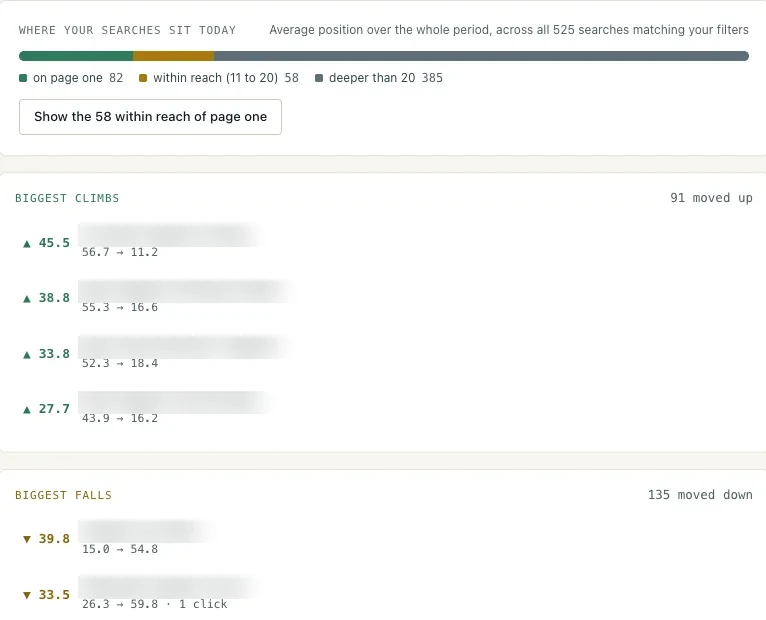
The other half of the picture is Google, and here Sondavo uses the one source that is not an estimate: your own Google Search Console account, read through Google's official API with read-only permission. It imports up to sixteen months of history, depending on plan, and shows every search that displayed your site, the position you held, and what people did next. Clicks and impressions are exact; positions are Google's own averages.
The useful part is the band between positions 11 and 20, which Sondavo calls within reach. Those are searches where Google already thinks your page is relevant but not yet good enough for page one, and they move furthest for the least work. Position eleven is not one place worse than position ten. It is page two, where almost nobody looks.
Rival positions and search volumes are a different kind of number. They come from licensed third-party data, they are estimates, and Sondavo labels them as estimates and keeps them apart from your Search Console figures. Where a check finds nothing it says so, rather than showing a zero that looks like a measurement.
What to do next, with the evidence attached
Most tools stop at the list of searches. Sondavo turns the list into a short set of jobs, ranked, with the reasoning on each card. The ranking comes from a fixed set of documented rules, not a language model, so the same data always produces the same list, and every item names the rule it fired on and the evidence behind it. Where one change would answer several searches, the searches are grouped into one job rather than shown as five.
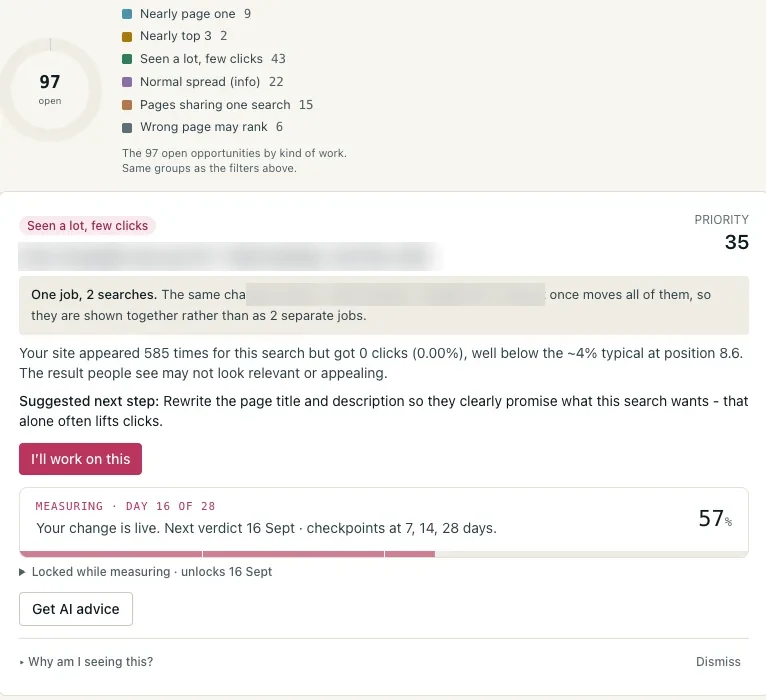
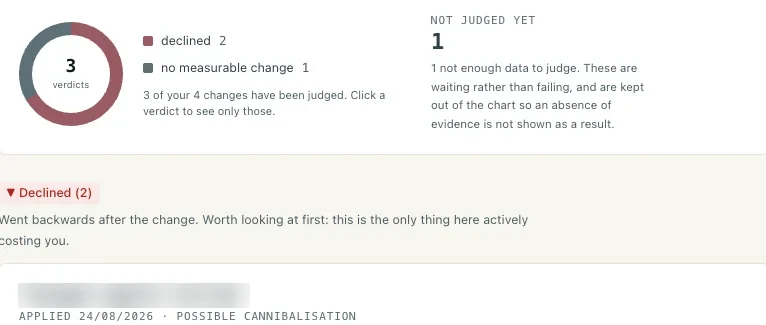
Marking a job done is not the end of it. Sondavo measures the searches that job targeted for the following 28 days, with checkpoints at 7, 14 and 28 days, using the same Search Console data, and returns a verdict you can check with arithmetic: improved, declined, no measurable change, or not judged yet when there is not enough data. An absence of evidence is never shown as a result.
Who is above you, and where their links come from
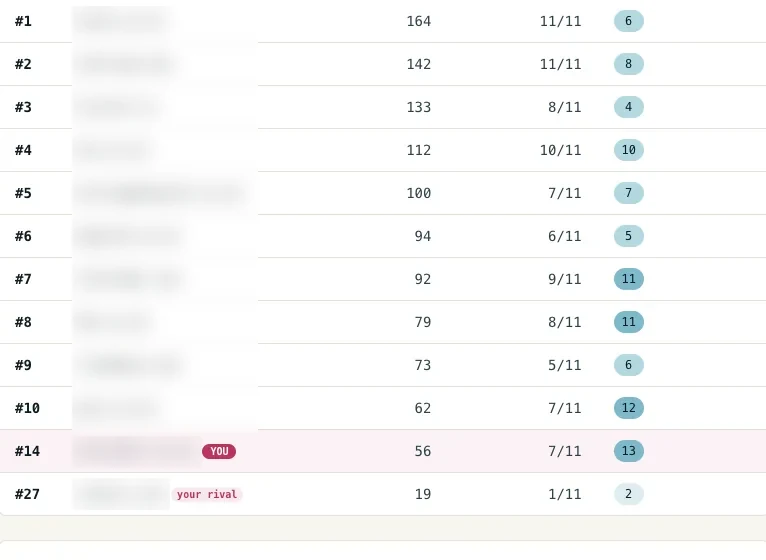
For every search you track, Sondavo records which sites appear and in what order, and builds a standings table from the results, with your own row in it. You can declare rivals you already know about, so a newer site with little history still gets compared. For any rival, a head-to-head view shows the searches where they sit above you and by how much, and the history is kept so changes appear as movements rather than snapshots.
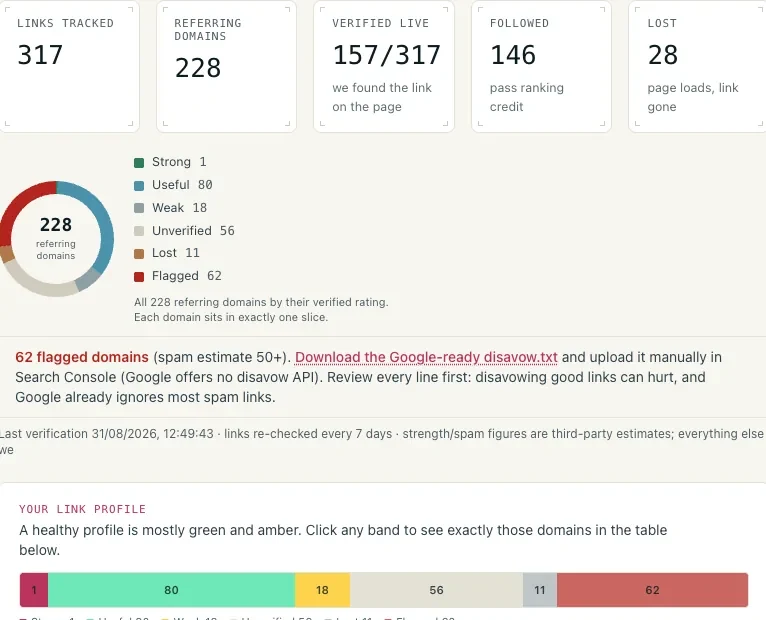
Links are handled the same way: fetched and verified by Sondavo itself rather than taken on trust from a provider, so a link marked live was found on the page. The link gap lists the domains that link to better-ranked rivals but not to you, separates the ones worth asking from the ones that are not, and watches a requested placement until the link goes live. Sondavo does not estimate anybody's traffic, revenue or budget. It reports what can be observed: which pages appear for which searches, in what order, and which sites link to them.
What is holding the site back, in plain English
Sondavo's own crawler reads your pages the way a search engine does. It records the response, title, headings, canonical tag, internal links and structured data, respects your robots.txt and your server's limits, identifies itself honestly, and stores only what a survey needs. Findings are written for the owner, not the developer: what it is, why it matters, whether it is worth fixing, and which pages carry it. They are ordered by what each one costs you, cosmetic issues are labelled cosmetic, and every finding names the rule that produced it, so you can dispute it.
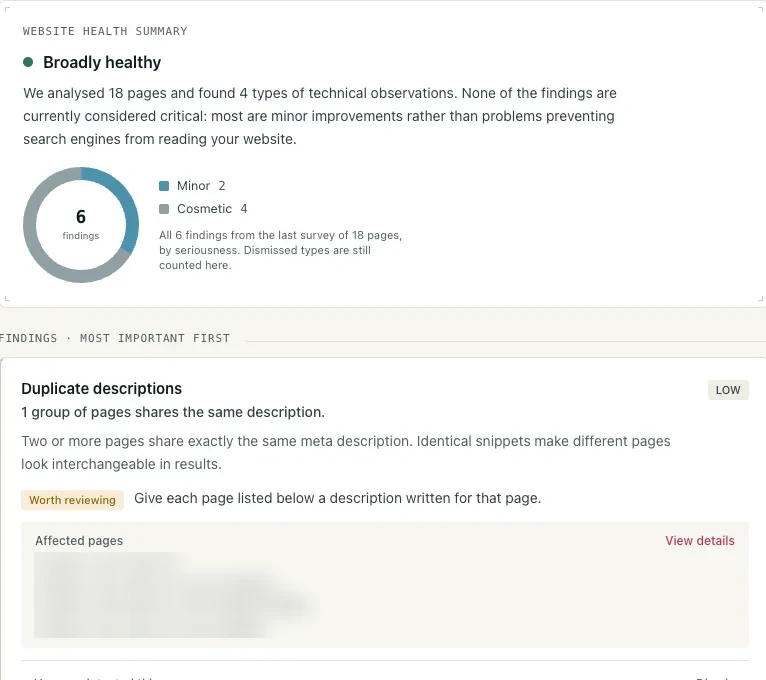
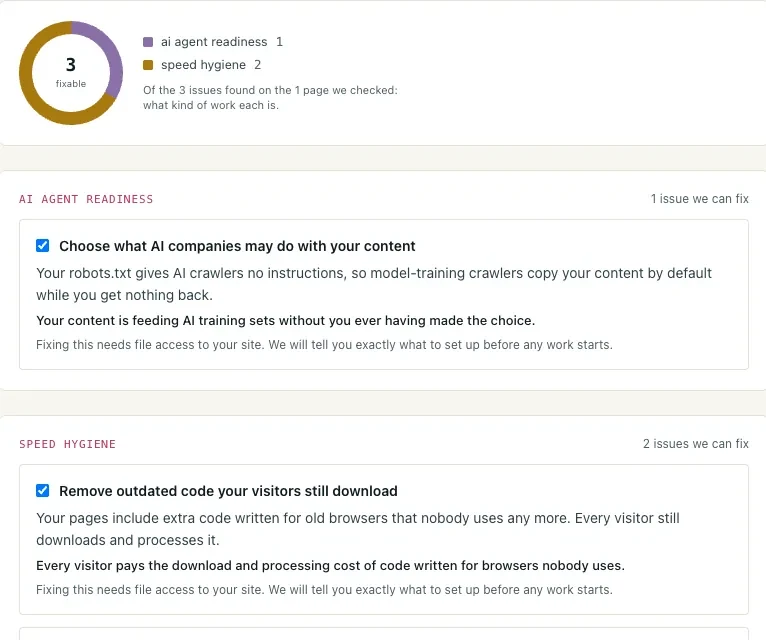
Each finding comes with the change that resolves it, at template level where that is the real fix. If you would rather not do the work, Sondavo's engineers quote each job first, and there is no fee if a fix does not pass its re-check. One group of findings ties straight back to AI: a robots.txt that gives AI crawlers no instructions means model-training crawlers copy your content by default, while the crawlers that could cite you and send visitors get no particular welcome.
The distinction that matters is between crawlers that answer live questions, which can cite you, and crawlers that collect training data, which send nothing back. Both are controlled by name in robots.txt, so you can allow one group and refuse the other.
| Crawler | Who runs it | What it does | Can it send visitors? |
|---|---|---|---|
| OAI-SearchBot, ChatGPT-User | OpenAI | Fetches pages to answer live ChatGPT questions and show sources | Yes |
| Claude-User, Claude-SearchBot | Anthropic | Fetches pages when a Claude user asks, and for Claude's search results | Yes |
| PerplexityBot, Perplexity-User | Perplexity | Fetches pages to build answers and cite sources | Yes |
| GPTBot | OpenAI | Collects training data | No |
| ClaudeBot | Anthropic | Collects training data | No |
| Google-Extended | Controls use of your content in Gemini training, separate from Googlebot | No, and blocking it does not affect Google Search |
Sondavo's guide to letting AI crawlers read your site covers the robots.txt lines for each.
AI visibility for online shops
Shops feel this first, because shoppers ask assistants the questions they used to type into Google: best X under a budget, where to buy Y in the UK, is Z any good. The assistant names three or four retailers, and the shopper goes to one of them. A shop that is not named loses the sale with no click, no impression and no sign in any report that it was ever in the running. That is why AI visibility for ecommerce needs its own question set: product and category questions, not the brand, and the questions change with the season.
Three things in Sondavo matter most for a shop. First, the buyer questions you monitor can be as specific as a category page, so you learn which categories the assistants recommend and which they ignore. Second, the within-reach band on the Google side is usually full of category pages that need a small push rather than a new page. Third, the technical faults that hide shop pages from Google also hide them from the assistants, because the assistants fetch pages the same way: canonical tags on filtered category URLs, redirect chains left by a replatform, a staging noindex header that travelled into production. Sondavo's crawler finds those, and for Magento stores on the Professional plan and above a Magento connector can apply metadata fixes to the store directly.
Timing is the part shops get wrong. The questions shoppers ask in November are being answered by the assistants from pages they read in September, so the question set and the fixes need to be in place before the peak season code freeze, not during it. If you run a Magento store, the Magento search visibility checks cover the faults specific to that platform, and Magento performance optimisation covers the speed findings, which affect both Google and the assistants.
What Sondavo does not do
- It samples four assistants: ChatGPT, Claude, Gemini and Perplexity. For Google's own AI Overviews and AI Mode, Google reports your impressions itself in Search Console's generative AI performance report, introduced in June 2026, and that is the right source for them because it is Google's data.
- AI answers are samples, not rankings. There is no stable position in an assistant's answer, only whether you were named and cited, how often, and what changed.
- It does not estimate rivals' traffic, revenue or budget. Where it cannot observe a thing, it leaves the cell empty rather than guessing.
- It does not read your CMS configuration and it does not replace a developer. Findings are a diagnosis to hand to whoever maintains the site, with the fix described.
- Your Search Console data stays yours. It is read with read-only permission, and nothing is published, indexed or shared unless you choose to share a report by link.
- It is not a hosting product. You do not need to host with EveryHost, or with anybody in particular, to use it.
Plans and the free check
Finding problems is free on every plan, and the free plan is not a trial: it works forever on one site. Paid plans add sites, frequency, history and AI answers. Prices are as published on sondavo.com/pricing on 16 October 2026.
| Plan | Price a month | Sites | Survey | History | AI answers a day | Also includes |
|---|---|---|---|---|---|---|
| Free | £0 | 1 | Weekly | 3 months | 3 | The free check, findings, opportunities |
| Starter | £19 | 1 | Every 3 days | 6 months | 10 | CSV exports, email alerts |
| Professional | £49 | 10 | Daily | 13 months | 25 | Competitor tracking, AI visibility, 3 teammates, Magento connector, API |
| Agency | £149 | 50 | Daily | 24 months | 100 | 15 teammates, white-label client reports, directory and citation sweeps |
Enterprise, with unlimited sites and answers, is priced on request. Fixes by Sondavo's engineers are quoted job by job and never added to a plan without your say-so.
Sondavo is built by the team behind EveryHost, Raplin Ventures Ltd, and this page is our own description of our own product rather than an independent review. Judge it on whether the free check tells you something useful about your site.
Frequently asked questions
See where your site stands today
Put your address in and get a free reading of where you turn up on Google. No account, no card, and the AI visibility report is one free sign-up away.