
Insights
What Shopify's Terms Say About Your Store: Suspension, Fees and Data
Shopify's Terms of Service let it suspend or terminate an account "for any reason, without notice and at any time (unless otherwise required by law)", and change its fees with 30 days' notice. UK merchants selling to consumers also have supplementary terms that list reasons for restriction or termination and set notice periods for changes to terms and pricing, and Shopify publishes an appeal route. None of that makes Shopify a bad choice, but it is worth knowing what you have agreed to and keeping your own copy of your data. Magento gives you more control of the software and more responsibility for it, and it does not remove every third party from your business.
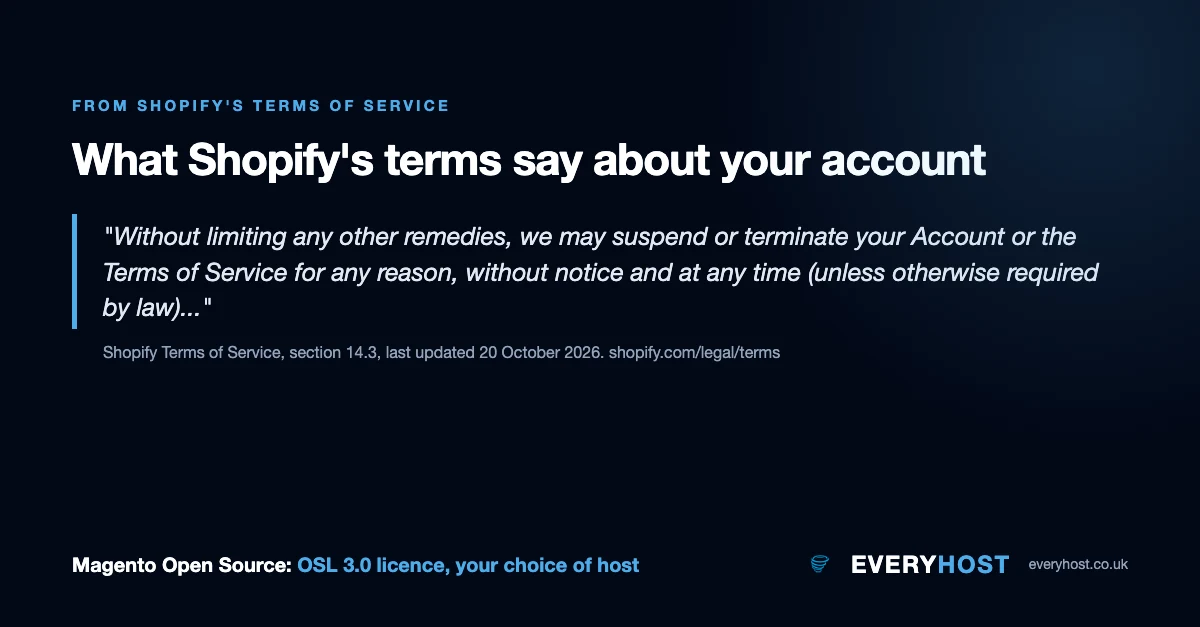
"Without limiting any other remedies, we may suspend or terminate your Account or the Terms of Service for any reason, without notice and at any time (unless otherwise required by law)..."
This is our reading of Shopify's and other vendors' published documents, checked on 4 November 2026, not of individual merchants' reports. It is not legal advice, and terms change, so check the current versions before you rely on them.
What the terms say about closing an account
Shopify's Terms of Service were last updated on 20 October 2026. Section 14.3 reads:
"Without limiting any other remedies, we may suspend or terminate your Account or the Terms of Service for any reason, without notice and at any time (unless otherwise required by law), including if we suspect that you (by conviction, settlement, insurance or escrow investigation, or otherwise) have engaged in fraudulent activity in connection with the use of the Services."
Section 14.4 sets out what follows when either side ends the agreement:
- You lose access: "you will no longer be able to access your Account".
- Fees already paid: "unless otherwise provided in the Terms of Service, you will not be entitled to any refunds of any Fees, pro rata or otherwise".
- Any balance owed becomes due immediately.
- The shop closes: "your Shopify Store will be taken offline".
The terms do not claim ownership of your content, but the licence is broad. Section 8.1 says: "We do not take ownership of the Materials that you provide to Shopify; however, we do require a license to your Materials." That licence is worldwide, transferable and sub-licensable, and it includes modifying your Materials and creating derivative works. The same section has you waive moral rights, lets Shopify review and delete Materials at any time, and keeps some licence rights alive after you remove your store.
UK merchants: read the supplementary terms too
Shopify also publishes Supplementary Terms for E.U. and U.K. Merchants, last updated on 14 February 2022. They "supplement and amend" the main terms "solely for E.U. and U.K. based Merchants who use the P2B Services", meaning the core services used to sell to consumers in the EU and UK. Where the two documents conflict, "the P2B Terms will govern, but only to the extent required to resolve such conflict or inconsistency". Shopify Payments, Capital and Shipping are outside them.
For merchants they cover, these terms add:
- Listed reasons. Restriction, suspension or termination "may happen for the following reasons": breach of the terms (as determined in Shopify's sole discretion), fees outstanding for longer than 60 days, an unresolved dispute over who owns the account, abuse, and suspected fraud.
- Notice of changes. At least 30 days' advance written notice of pricing changes and at least 15 days for other substantive changes, unless the regulation permits less. This section covers changes to terms and pricing, not notice before termination.
- Complaints. A free internal complaint-handling system, and mediation if Shopify agrees to it. The complaint form they link to is worded for E.U. merchants.
- Law and courts. The main terms on their own choose the laws of Ontario and Canada. For merchants these supplementary terms cover, Irish law governs, and disputes go to the courts named in section 13 of the main terms. For Shopify International Limited, the company these terms name, that is the Courts of Ireland. Neither document chooses English law or a UK court.
These terms describe the core services they cover as subject to the UK version of the platform-to-business regulation. Article 4(2) says a provider of online intermediation services ending its whole service to a business user must give a statement of reasons "at least 30 days prior to the termination taking effect", with exceptions in Article 4(4). Article 4(1) requires a statement of reasons at or before a restriction or suspension relating to individual goods or services, and Article 4(3) gives the business an opportunity to clarify the facts through the complaints process. Article 1 says the regulation applies to UK-established businesses selling to UK consumers "irrespective of the law otherwise applicable" to the contract. How all of that works alongside section 14.3 for your store is a legal question. If it matters to your business, ask a solicitor.
Suspend or terminate for any reason, without notice, unless law requires otherwise.
For merchants they cover: list reasons for restriction, suspension or termination, at least 30 days' notice of pricing changes unless the regulation permits less, and priority where the two conflict.
Where it applies: a statement of reasons at least 30 days before ending the whole service, with exceptions.
How these fit together for your store is a legal question.
How Shopify describes using these powers
Shopify's Acceptable Use Policy is more measured than section 14.3: "When you build on Shopify with these principles in mind, we will give you notice, grant you opportunities to self-remediate conflicts, default to enforcement at the product level, and take account-level action as a last resort when appropriate." The same policy says account-level action is often more appropriate for fraud, spam and similar practices.
Its help page on store termination describes restricted access, which it says is commonly based on activity that is, or is suspected to be, not a legitimate commerce practice. "Stores may be placed in restricted access without prior communication." While restricted, the storefront is unavailable to customers, billing is paused, and you keep limited admin access, including an appeal form. The page gives no decision timeframe and promises no outcome.
Missed bills work differently. Shopify says a store "remains fully active and continues accepting orders" during a 28-day retry period, then freezes if the invoice is still unpaid. On a frozen store, "you can't access your Shopify admin and customers can't view your store" until it is reactivated, and you need to reactivate it before you can reach its information. If fees stay unpaid for 60 days after suspension, section 5.4 says Shopify may terminate the account.
Shopify retries the payment
Still taking orders for 28 days from the first failed attempt
If still unpaid: no admin, and customers can't view it, until reactivated
If fees stay unpaid 60 days after suspension
From Shopify's Help Center, which says frozen, and section 5.4 of its Terms of Service, which says suspended.
Shopify Payments has its own terms, which cover suspension, termination and reserves. Shopify's help pages describe a reserve as a temporary hold on some or all of the funds from transactions, which it says generally does not stop you accepting payments. It says you can appeal by replying to the reserve email, although some reserves can't be appealed. During an account hold you can still use your store, and in most cases customers can still check out, but "you can't receive payouts through Shopify Payments until the reason for the hold is resolved".
What can change on fees, and what has changed
Section 15.2 reads: "Shopify may change the Fees for the Services from time-to-time. We will provide you with 30 days advanced notice prior to any changes in Fees by sending an email to the Primary Email Account, providing notice through the Shopify administrative console, or by similar means."
Shopify has changed its prices before, and its Basic, Grow and Advanced UK list prices have not moved since the 2023 change:
- 2023. Shopify announced updated pricing for its Basic, Shopify and Advanced plans on 23 January 2023, effective for new merchants the next day and for existing merchants on 23 April 2023, 90 days after the announcement. Archived copies of its UK pricing page show monthly prices of £19, £49 and £259 on 1 January 2023 and £25, £65 and £344 on 3 February 2023. Shopify's current pay-yearly rates are £19, £49 and £259 a month.
- 2024. Shopify says it updated pricing for Plus plans and Shopify Payments, effective for new Plus merchants on 8 February 2024.
- Since then. The Basic, Grow (the renamed Shopify plan) and Advanced UK plan prices on the live page match those 2023 figures, and the archived pages we sampled through to October 2026 show no change in them. Another fee has moved: the third-party transaction fee on Advanced was 0.5% in an archived copy of 5 December 2023 and 0.6% in one of 12 March 2024.
Archived copies of Shopify's UK pricing page, paying monthly. Bars are scaled within each plan. New merchants moved on 24 January 2023 and existing merchants on 23 April 2023. The live page still shows £25, £65 and £344 paying monthly, and £19, £49 and £259 a month paying yearly.
If you use a payment provider other than Shopify Payments, Shopify's UK page lists third-party transaction fees of 2%, 1%, 0.6% and 0.2% by plan, and your provider will have its own charges as well. PayPal is exempt if Shopify Payments is your primary provider. Our Magento vs Shopify comparison has the plan and fee table.
Fee changes are not only a Shopify question. Archived copies of Gumroad's own pages show tiered fees of 9% down to 2.9% plus $0.30 in November 2022 and a flat 10%, excluding processing by early 2023.
Is this unusual?
Not on this sample. We read the current terms of four other hosted platforms. This is a sample, not an industry survey, and enterprise contracts can differ.
| Platform (terms date) | Ending an account | Changing fees |
|---|---|---|
| Shopify (20 Oct 2026) | Any reason, without notice, unless law requires otherwise. UK terms list reasons and describe the services as subject to the UK regulation | 30 days' notice |
| Wix (22 Oct 2026) | Any reason, with or without prior notice | Notice if existing subscriptions are affected, no period stated. A general clause also reserves changing prices with or without prior notice |
| Squarespace (27 Mar 2025) | Sole discretion, without notice. It says it will endeavour to give reasonable notice | Advance notice, no period stated, and you can cancel before your next payment |
| BigCommerce, from Commerce (agreement dated 1 Jun 2026) | With or without cause on written notice, enterprise customers excepted. At least 30 days for UK businesses, subject to exceptions. Its store terms also allow suspending or terminating access with or without notice | At least 30 days' notice |
| Lightspeed (26 Feb 2026) | Within a term, listed grounds, some immediate and without notice. Either side can stop renewal on written notice. It also has an early termination fee | 30 days' written notice |
So on contract wording alone, Shopify's clause on ending an account is among the broader ones in this group, level with Wix and Squarespace, and its stated 30 days on fees is as specific as any. Statutory rights may apply on top for UK merchants on any of them.
Keep your own copy of your data
Shopify's documents give different retention figures, and none we read explains how they fit together for a store that has not asked for deletion. Its help page says a store you deactivate has its information "guaranteed for 2 years". Its Merchant Privacy Policy says that if you close your store, stop paying or Shopify terminates your account, "we retain store information for two years before we begin the process of deleting or anonymizing personal information". The UK and EU supplementary terms say: "Within 90 days of termination all personal information within your Store is deleted except as legally required." They add that non-personal and aggregated information is retained, and that on request, within 60 days after you end the services, Shopify will provide personal information that relates to you. The Privacy Policy separately says that if you ask for deletion, the process begins after 90 days.
Retention is not the same as access. Reactivating is the route Shopify describes for a store you closed yourself. In the pages we read, we found none that promises you a way to export your store after Shopify has terminated it. The GDPR, UK GDPR and Switzerland appendix of its Data Processing Addendum does say: "Following termination, Shopify will, at Your choice, delete or return Your Customer Personal Data." It also allows retention as required by law and under Shopify's standard backup or record retention policies, and it covers customer personal data, not your products, theme or content.
The practical answer is to export while the store is open, on any platform.
- Products
- Customers
- Orders
- Discount codes
- Financial data
- Product imagesCSV holds URLs, not files
- Gift cardsOn the list, but the standard export holds the last 4 characters of each code
- ThemeSeparate download, check its licence
- App dataVaries by app
- PagesCopy, API or app
- Blog postsCopy, API or app
On Shopify:
- Export products, customers, orders, discount codes and financial data as CSV files, using Shopify's backup list
- Download product images separately, because the product CSV holds image URLs, not the files
- Check gift cards: the standard export holds only the last 4 characters of each code
- Copy pages and blog posts: Shopify's backup list does not include them, so use copy and paste, its APIs or an app
- Download your theme, and check its licence before reusing it
- Export app data where the app allows it: Shopify warns some cannot be recovered after uninstalling
- Export your URL redirects
- Know who controls your domain: Shopify's domain page says a domain it manages can be transferred from a paused, deactivated or frozen store, though its frozen-store page says you must reactivate first, and neither covers restricted or terminated stores. A .uk domain goes through Shopify Support with an IPS tag from your new provider
What Magento changes
Third parties don't disappear on Magento. They change.
You hold an open source licence. Magento Open Source and Mage-OS are released under open source licences. OSL 3.0 grants "a worldwide, royalty-free, non-exclusive, sublicensable license, for the duration of the copyright". In section 15 the licensor "promises not to interfere" with uses the licence and the law allow. It has conditions: it ends if you fail to honour section 1(c), the OSL licensing condition on distribution, which section 5 extends to making the software or your changes to it available over a network, or if you bring a patent claim over the software. We found no clause letting the licensor end it at will. It also comes "AS IS", with no warranty on quality. It is a licence, not ownership.
You choose where it runs. Your code and database sit on a server you choose, and you can move them to another host without a platform's permission.
The software takes no cut of your sales. Magento Open Source and Mage-OS have no licence fee and no platform transaction fee. You still pay for hosting, development, extensions and your payment provider. Our Magento hosting cost guide covers the full picture.
Adobe Commerce is different. It is Adobe's paid edition. The on-premise licence terms we could read describe "a limited, personal, revocable, non-exclusive" licence, and Adobe's product description ties pricing to tiers such as gross merchandise value. Read your own agreement.
What Magento does not change
Adobe is still upstream. Adobe's install guide uses repo.magento.com with access keys from its Marketplace, and its Marketplace agreement reserves the right to "modify, suspend or terminate operation of or access to" the Marketplace. It does not say whether that reaches those keys. Mage-OS runs a public mirror that needs no Adobe account, and it is sensible to keep your own copy of your code.
Paid extensions have their own licences. Adobe's Marketplace guide also says purchases cannot be moved to a new account.
Your payment provider has terms too. Stripe's UK agreement says: "Unless otherwise agreed in writing, Stripe may terminate this Agreement or close User's Stripe Account at any time. Stripe will notify User in accordance with Law." It gives at least 30 days' notice of fee increases. PayPal's UK agreement says it will "usually give you at least 90 days' notice" before closing an account, and lists reasons it can close one immediately. Leaving Shopify does not remove this risk.
Security becomes your job, or your host's or developer's. On Shopify, the platform is maintained for you. On Magento, someone has to apply patches and watch for trouble, as flaws such as StyleSmuggler and PHP2Shell showed. Adobe also says its extended support patches "are not available for the Magento Open Source code base". And in a notice about end-of-life PHP versions, Adobe's lifecycle policy states: "PCI compliance is the merchant's responsibility to assess." See our PCI guide.
Your host has terms too, including us. Our terms say we may suspend or terminate accounts that break our acceptable use policy "with or without notice depending on severity", and that we may suspend immediately for a serious breach or security threat. Plans renew "at the then-current rate", with "reasonable efforts to notify you of any price changes in advance". After termination we keep data for "a reasonable period (typically 14 days)". The practical difference from a hosted platform is that, while you have access, you can take a complete copy of your code and database yourself and run it elsewhere. If you have not kept one and your account is suspended or ended, you are relying on your host, as you would on any platform. Our terms strongly recommend keeping at least one recent copy "in a location outside our infrastructure and outside our control".
What moving from Shopify to Magento involves
It is a real project, and it is not covered by free migration offers aimed at Magento host moves, including ours.
- 1Export from Shopify
- 2Reformat for Magento's import
- 3Move orders by another route
- 4Add 301 redirects
- 5Rebuild theme, replace apps
- 6Test, then go live
With us this is a quoted project. Free migration covers moving an existing Magento 2 store to us from another host. Moves off Adobe Commerce Cloud are quoted.
- Data. A Shopify CSV has to be reformatted to Adobe's import structure. Magento's native import lists products, customers and related data, but not orders, so orders need another route.
- Passwords. Shopify's customer export lists no password column, so plan for customers to set new ones or use a new sign-in. Stores already on passwordless Shopify accounts may have none to move.
- URLs. Shopify's standard paths, such as /products/, usually need 301 redirects in Magento to protect your search rankings.
- Theme and apps. In our view, a Shopify theme needs rebuilding for Magento, and each app needs replacing with an extension or custom work.
It cuts both ways. Adobe's Data Transfer export does not list orders either, although the Orders grid can export selected records as CSV or Excel XML, and Shopify's own migration guide offers more tooling for moving onto Shopify than Adobe documents for moving from it.
When staying on Shopify makes sense
For a straightforward catalogue, no developer on hand and no need to change how checkout works, Shopify is often the sensible choice, and these clauses are not by themselves a reason to leave. Keep your exports current, read the terms that apply to you, and think about what your business would do if the store went offline for a week.
Magento is worth the extra responsibility when you need control of the code, complex catalogues or B2B selling beyond what Shopify offers (on Open Source that means extensions, as Adobe's B2B module is Adobe Commerce only), and you have a developer and good hosting behind you. Our Magento vs Shopify comparison goes through that decision.
How EveryHost fits in
We host Magento stores on a managed VPS from £119 a month + VAT, or a dedicated server from £249 a month + VAT, in our London data centre. See all plans and prices. Plans are monthly rolling with no lock-in, and annual billing is optional.
Standard support comes with every plan. If you want more looked after when your server is built, Managed is £85 a month + VAT and Fully Managed is £269 a month + VAT, which includes applying Magento security patches, staging first.
If you already run Magento 2 elsewhere, our free migration moves it to us, although a move off Adobe Commerce Cloud is quoted. A move from Shopify is a quoted project, so talk to us about your store first. We can also host Mage-OS, and we have an explainer on what Mage-OS is.
We also posted about sections 14.3 and 15.2 on LinkedIn.
Sources
All accessed 4 November 2026. Archived pages are copies of the vendors' own pages held by the Internet Archive.
- Shopify Terms of Service, last updated 20 October 2026
- Shopify Supplementary Terms for E.U. and U.K. Merchants, last updated 14 February 2022
- Shopify Acceptable Use Policy
- Shopify Merchant Privacy Policy, last updated 25 July 2025
- Shopify Data Processing Addendum
- Shopify Payments Terms of Service
- Shopify UK pricing
- UK version of Regulation (EU) 2019/1150, Article 4
- Open Software License 3.0 as shipped with Magento
- EveryHost terms, last updated 13 October 2026
Frequently asked questions
Weighing up where your store should live?
Tell us about your store and we will give you a straight answer, including if staying where you are is the right call.